

What is the fracture toughness of paper?
Fracture toughness or fracture resistance of paper is a way to describe the process of paper breaking.
Fracture toughness refers to the ability of paper to absorb energy in the fracture zone when it resists breaking. Suppose there is a weak point in the paper, such as a crack or a tear in the paper. Fracture toughness is a measure of the energy required to expand the crack or tear.
Fracture toughness is related to the force that paper can withstand when subjected to external forces or the elongation of paper, but it describes a different concept and provides more information than tensile testing (tensile testing). In simple terms, tensile testing describes the process before the fracture point occurs; fracture toughness describes the process after the fracture point occurs in the paper.
Fracture toughness is related to but not the same as tensile strength. The tensile strength of paper refers to the ability of paper to withstand loads without breaking. It reflects how much force the paper can withstand without breaking when subjected to tensile forces. Tensile strength is usually expressed as the maximum force per unit width area, such as kilonewtons/meter² (kN/m)²).
When there is a weak point in the paper, the paper with good fracture toughness can withstand more stretching or deformation than the paper with poor fracture toughness when subjected to the same tension or stress, instead of breaking immediately. Currently, there is no easy way to accurately measure the fracture toughness of paper. The fracture toughness of paper is usually obtained through laboratory tests, such as measuring how much energy the paper can absorb before breaking under specific conditions.
Importance of fracture toughness
The paper fracture process itself is very interesting and different from the process that occurs on the paper before the fracture begins. In the field of industry and research, fracture toughness is an important performance indicator that determines the suitability and durability of paper in various applications.
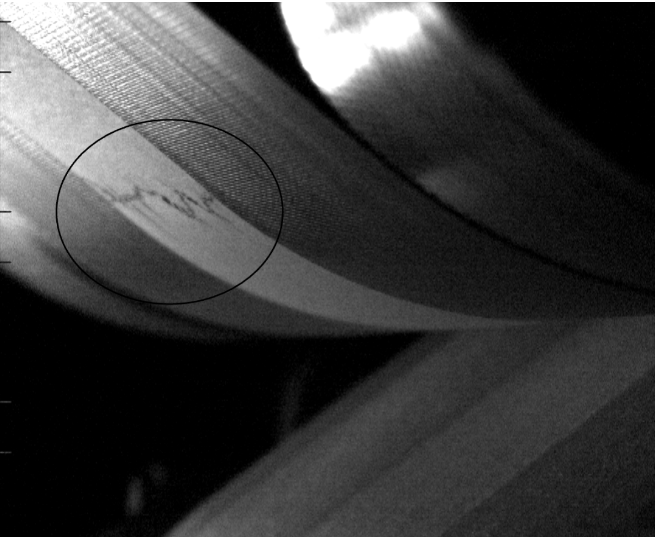
Fracture toughness is very important for the paper feeding, conveying, and reel changing processes of packaging paper, tape, printing paper, and industrial web paper during their production and use. The following picture was taken by the Technical Research Center of Finland (VTT) with a high-speed camera, showing the situation when the wet paper web breaks on the dry web (after wet pressing) when producing a small width of paper on a pilot paper machine.
Another interesting detail is that studies have shown that the fracture process of paper is very similar to the fracture process of earthquakes, wood or other materials.

Ductile fracture of trees. The larger the fracture area, the more energy is required.
Energy is the key
Now let’s talk about energy. When paper is subjected to a certain amount of stress, fracture bands, cracks or defects will appear on the paper. It takes energy to further expand these cracks or defects, and the key lies in the degree of stress concentration. If the stress is concentrated in a very small area, then only a small stress is actually required to expand the crack.
In theory, there are two energy-consuming mechanisms for paper breaking: fiber breakage and the work required to extract the fiber from the fiber network structure. As we all know, work is equal to force multiplied by distance.
The force required for fiber breakage is large, but the distance at this time is very small, even close to zero, so the energy required is very small, which means that the fracture toughness of the paper is very small.
When the fiber is pulled out of the paper (or fiber network structure) (as shown in the figure below), the force required is much less than the force required to break a single fiber. At this time, the longer the distance the fiber is pulled out of the paper, the more energy is required to break, and the greater the fracture toughness of the paper.
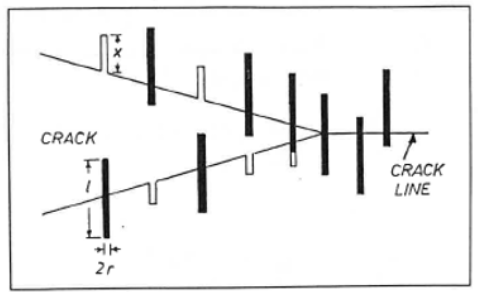
Schematic diagram of fibers being extracted from the paper fracture zone
In other words, it takes more energy to extract longer fibers from a sheet of paper than it does to extract shorter fibers (as shown in the figure below). This is why paper made from long fibers (such as softwood pulp) has better fracture toughness than paper made from short fibers (such as hardwood pulp).
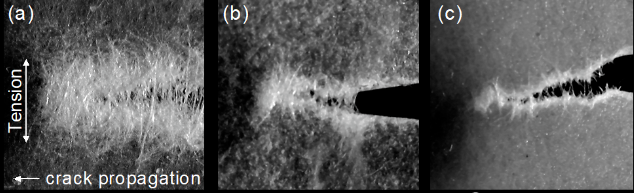
As the fiber length increases (from right to left), the fracture process zone (the area where energy is consumed) becomes larger and the energy becomes higher.
In addition, the force required to extract the fibers from the paper also depends on the strength of the fiber-to-fiber bonds in the paper. When the number of fiber-to-fiber bonds increases, the fibers become more difficult to extract, and the paper breaks when the fibers break. When the fiber-to-fiber bond strength is low, the energy required to break the paper increases as the fiber-to-fiber bond strength increases.
Fracture toughness test
Before talking about the test of paper fracture toughness, it is necessary to introduce the tear strength of paper. The tear strength of paper refers to the ability of paper to resist tearing. It is an important indicator of paper durability and strength, especially when the paper is subjected to irregular or uneven stress. Tear strength is the energy required to produce a specific tear length.
The Elmendof tear strength test is an out-of-plane tear test and a common way to evaluate fracture toughness. Although the in-plane tear test is less common, it is a better test method to evaluate the fracture toughness of paper (as shown in the figure below). In the industrial production process, the stress on paper is often in the plane. The in-plane tear test can better simulate and predict the situation of paper breaking in actual application scenarios.
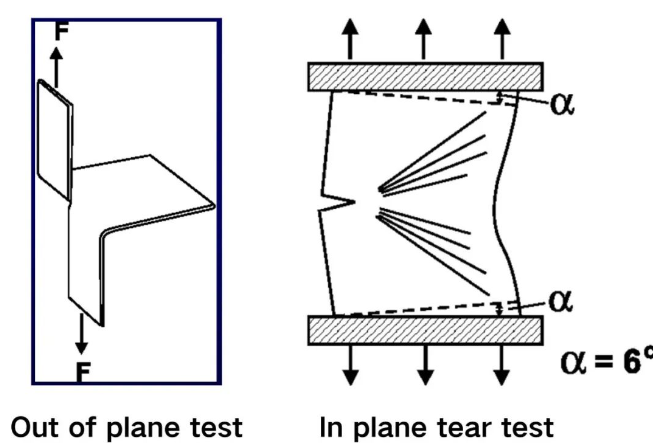
Schematic diagram of out-of-plane tear test and in-plane tear test
Key factors affecting fracture toughness
The figure below is a graph showing the relationship between the fracture toughness and tensile strength of paper based on a simplified theoretical model.
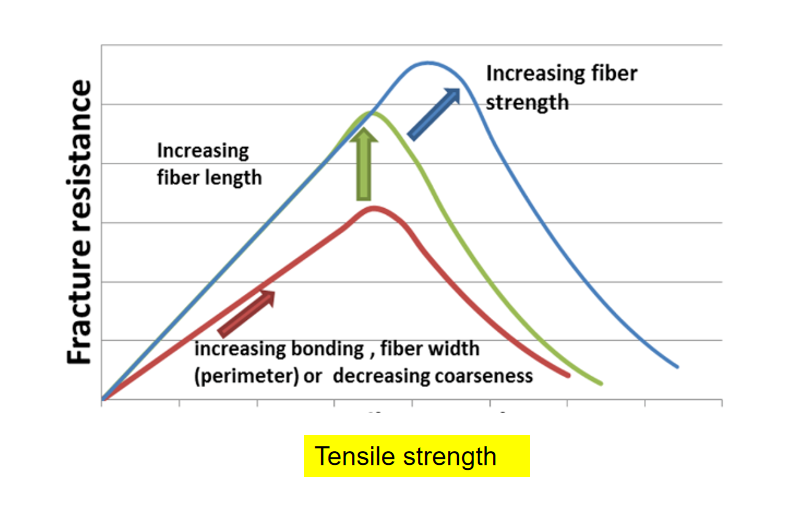
From the figure we can see (red curve), when the inter-fiber bonding strength increases (i.e. increasing fiber width, or reducing coarseness, etc.), the fracture toughness and tensile strength of paper will increase simultaneously within a certain bonding strength range. When the bonding strength reaches a certain peak value (the highest point of the red curve), the fracture toughness of paper begins to decrease, while the tensile strength continues to increase.
In addition to bonding strength and the number of bonding points, fiber length and fiber strength also play a very important role. If we convert the fracture toughness (tear strength) of paper into a function with tensile strength as a variable, we will get an interesting result: when the tensile strength remains unchanged, the fracture toughness (tear strength) of paper can only be improved by increasing fiber strength (blue curve) or fiber length (green curve), and the maximum value of the fracture toughness of paper is determined by the size of the fiber strength.