
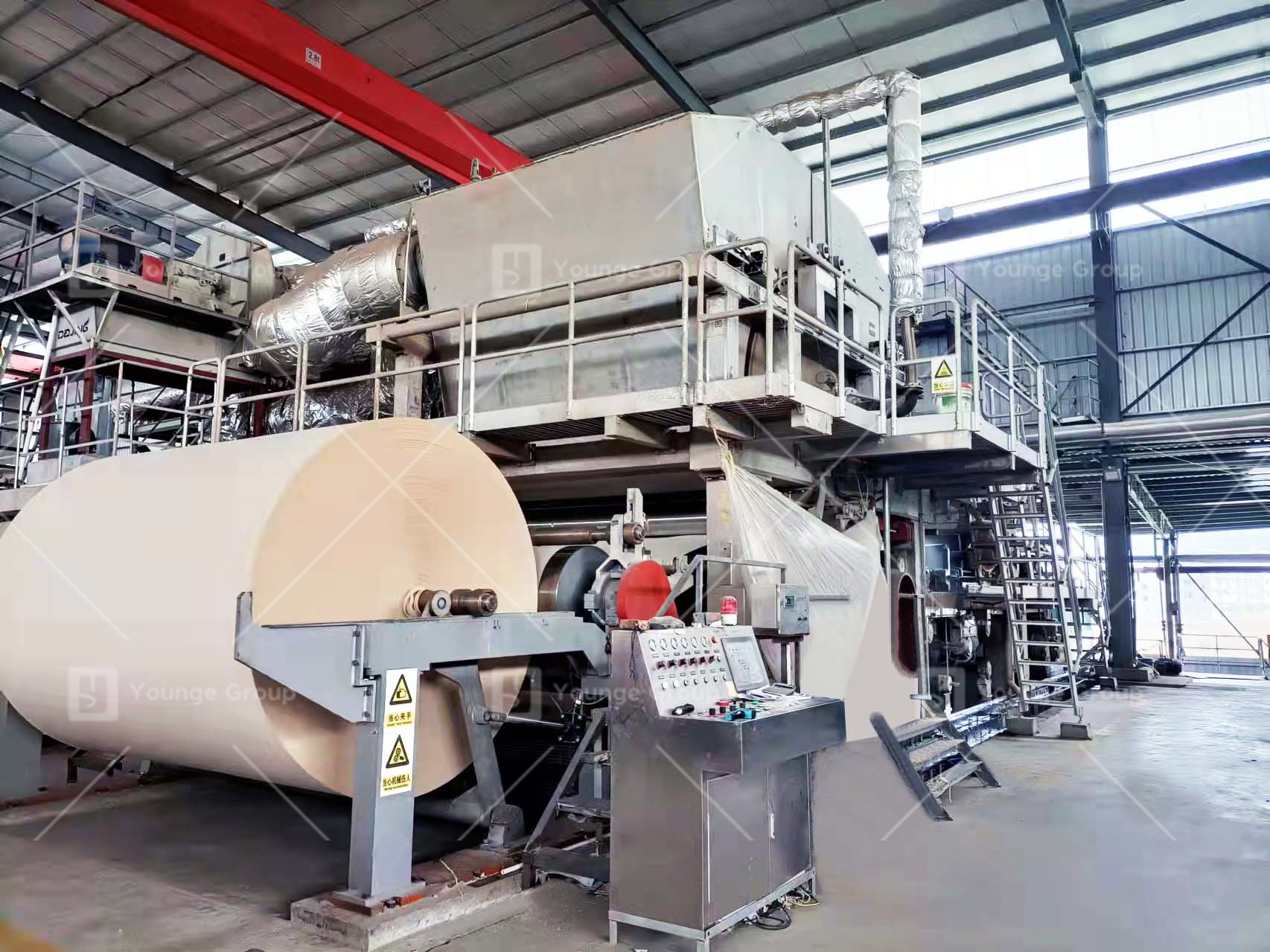
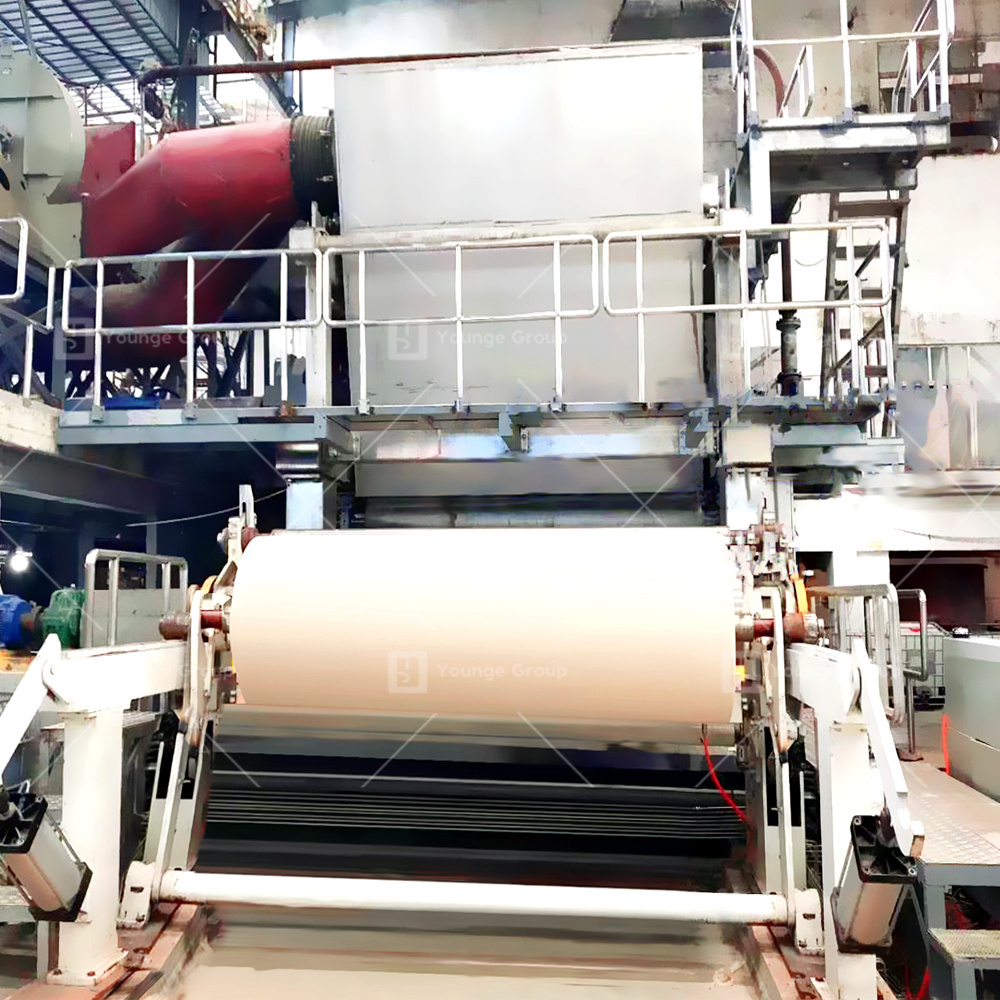
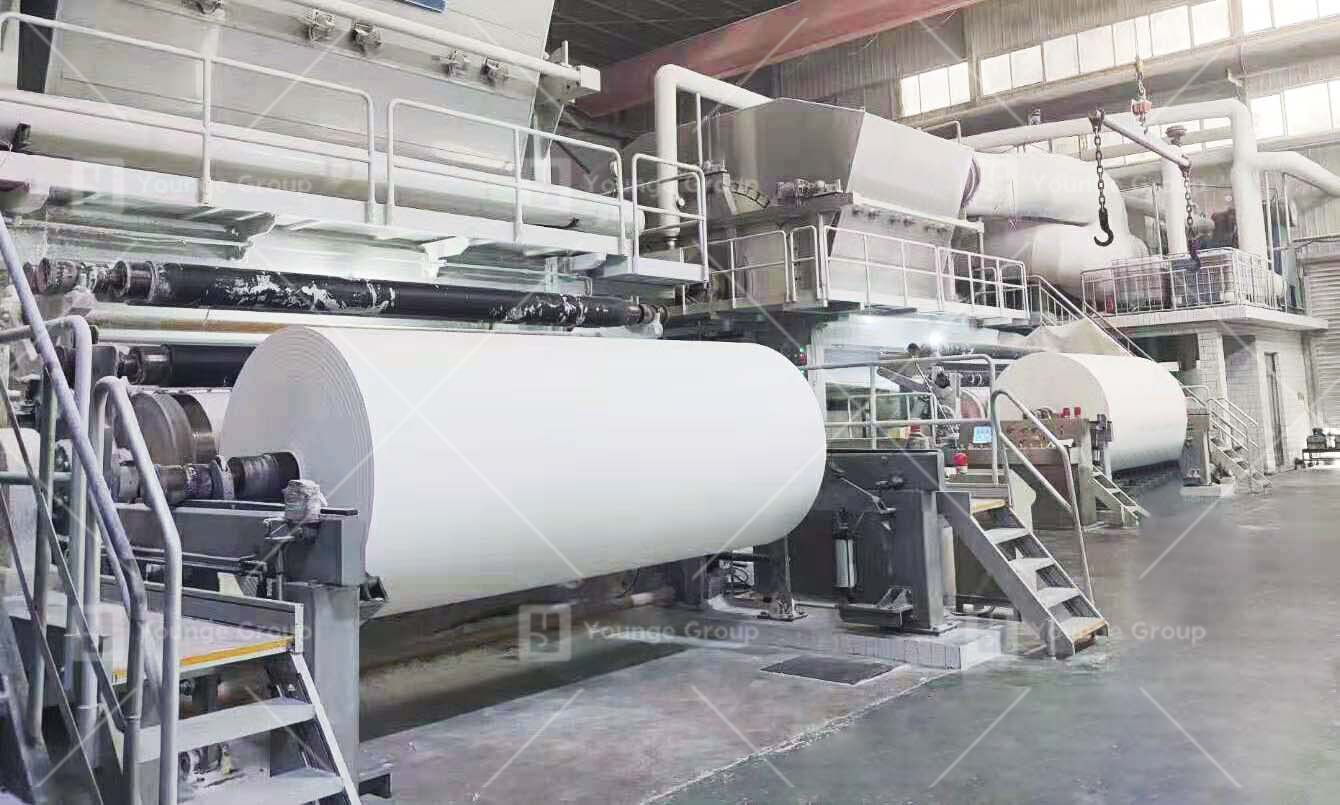
High Speed Crescent Former Tissue Paper Machine is designed and manufactured based on modern paper machine concepts such as wide width, high speed, safety, stability, energy saving, high efficiency, high quality and automation. Crescent Former Tissue Paper Machine meets the market’s demand for high-speed tissue paper machines and the user’s demand for high-quality tissue paper production. It is a powerful guarantee for paper mill enterprise to create value, upgrade and transform, establish reputation, and open up the market. Crescent Former Tissue Paper Machine includes: crescent-type hydraulic headbox, crescent former, blanket section, Yankee Dryer, hot wind breathing hood system, creping blade, reeler, transmission section, hydraulic&pneumatic device , vacuum system, thin oil lubrication system.
wood pulp ,wood virgin board,rice straw, cotton, bagasse, bamboo etc.
| 1.Raw material | Bleached Virgin pulp(wood pulp,bamboo pulp,straw pulp); Recycle White Cutting |
| 2.Output paper | High grade Jumbo Roll for Facial tissue paper and Toilet paper |
| 3. Output paper weight | 12-25g/m2 |
| 4.Capacity | 25-50 Tons per day |
| 5. Net paper width | 2850-3600mm |
| 6. Wire width | 3300-4000mm |
| 7.Working speed | 500-1000m/min |
| 8. Designing speed | 1200m/min |
| 9. Rail gauge | 3900-4600mm |
| 10. Drive way | Alternating current frequency converter speed control, sectional drive. |
| 11.Layout type | Left or right hand machine. |
1.Dry crepe tissue or Crescent former
By far, the most common tissue machine concept used today is the Crescent Former, also called a Dry Crepe or conventional machine.
The simple Crescent former concept uses only two pieces of machine clothing: A forming fabric and a press felt,The Crescent former traps the stock between the forming fabric and a felt, avoiding the need to transfer the sheet to a felt later in the process. Before Crescent formers became widely adopted, the Twin-Wire former followed by a press felt was commonly used in the industry.
In the Crescent former, a water jet containing the stock mixture of water and fibers is ejected at high speed from the headbox. The web is then formed by trapping it between the forming fabric and the felt as they wrap around a large, solid forming roll. Initial drainage takes place around this forming roll, with the wire tension determining the drainage capacity. The drainage pressure, P, is described as P=T/R, where T is wire tension and R is forming roll radius.
The most common forming roll diameter is 1.5 m. The drainage capacity provided by this diameter is sufficient for basis weights up to about 40 gsm but, at such high weights, speed is limited of about 1400 m/min. As most tissue products have a basis weight in the range 13-25 gsm, the drainage capacity is sufficient for high-speed operation up to 2200 m/min, which is essentially the fastest machine speeds achieved so far in the industry.
2.Pressing
The tissue sheet web is carried on the felt and then transferred to the Yankee in the first press nip. The first press roll is normally a suction roll which has a wide suction box of 80-110°. Over that suction zone water is removed both from the web and the felt. The web dryness is increased up to about 25% before the press nip and then typically rises to around 40% or more after the press. The linear load is typically 90-100 kN/m, which corresponds to a peak pressure of about 2.5 MPa in the nip.
By adding a second press roll, the dryness can be increased by 2-4%. The second press nip, however, reduces the sheet caliper, but at the same time generally improves tensile strength. Since the hood wrap can be increased to give a longer drying zone when no second press roll is used, the production output is very similar for the two press concepts, but the single roll concept has a higher drying cost.
Most tissue machines have only a suction press roll, with the main reasons being the higher bulk it offers and the lower investment cost. Occasionally, a steam shower is installed at the first press roll over its vacuum zone to heat the web and reduce the water viscosity, for improved water removal. Some steam showers also have cross-direction control zones for improving sheet moisture uniformity.
3.Yankee dryer
On a conventional dry crepe tissue machine the sheet is dried on a single large cylinder called a Yankee dryer. The Yankee not only supplies the required energy for the drying of the web but also has three other functions:
– To transport the sheet during the drying process
– To function as a counter roll in the hot-pressing operation
– To provide the base for the creping process.
The drying capacity of a tissue machine is mainly affected by the size of the Yankee dryer.
4.Creping
The creping process is a delicate operation requiring a perfect balance between the adhesive forces holding the sheet to the dryer surface, the physical properties of the un-creped sheet, and the forces applied by the doctor blade. Creping is basically done by doctoring, or scraping, the sheet off of the Yankee surface by using the proper creping geometry provided by the doctor blade. Folds and micro-folds will then be introduced into the sheet in the cross direction, which means the sheet decreases in length by 10-25%. The reduction in length is managed by running the reel at a lower speed than the Yankee.
The final quality of the tissue, and especially the softness, is greatly dependent on the creping. Creping gives the paper higher bulk and improves softness, absorbency, and stretch. It also reduces the tensile strength. Most tissue is creped at 93-97% dryness levels.
Tissue machines normally have three doctors of which the creping doctor is the middle one. Before the creping doctor, a cut-off or skinning doctor is installed and is in use only when the creping doctor blade is being changed. After the creping doctor blade, a cleaning doctor is often used in the last position to remove fiber and excessive coating.
The dry end of the tissue machine has a reel for winding the tissue sheet. As mentioned, the reel runs at lower speed compared to the Yankee dryer, because creping shortens the sheet. The speed difference can be in the range of 10-25%. This speed difference is called crepe ratio and is defined as [1-(reel speed/Yankee speed)]x100%.
Toilet tissue is normally produced at a 17-20% crepe ratio while kitchen towels are in the range of 15-18%. The creping process increases the bulk by about 100%, but it reduces the tensile strength by almost 50%. Typical bulk is in the range of 8-9 cm3/g for the best products. The Yankee side of the base sheet is softer compared to the hood side. In the converting process where the finished products are made, the Yankee side is placed as the outside in a 2-ply product to get the highest product softness.
Some tissue machines have a calender before the reel which is used to improve surface softness and reduce CD caliper variation in the sheet on the reel. The calender is used when producing facial tissue or high-quality toilet tissue. At high-machine speed operation, it is necessary to use active foils to support the sheet through the dry end.
We will contact you within 1 working day, please pay attention to the email with the suffix “@jennypapermachine.com”.