

Color of cellulose fiber
The cotton T-shirts we often wear are made of cotton fiber, the main chemical component of which is cellulose; if you like to wear “modal” underwear, it is usually made of viscose fiber. Viscose fiber is a regenerated cellulose, which is made by dissolving and separating natural cellulose, and then solidifying or coagulating it into filaments. Viscose fiber is the main variety of man-made cellulose fiber, and its main raw material is chemical wood pulp (https://jennypapermachine.com/what-is-plant-fiber-for-papermaking/).

T-shirts can be white, black or red, so what color is cellulose fiber? You might think it is white. But actually it is not.
If you look closely at a single cellulose fiber, it is actually colorless and basically transparent.
However, we all know that bleached kraft pulp and cotton are white, so how does the white color come from?
The principle here is the same as the phenomenon of ice and snow. Both ice and snow are frozen water. Ice is transparent, while snow is white. The difference between the two comes from the geometry, surface area and pore structure of the material.
Optical phenomena
These optical phenomena are very interesting, but they are also much more complicated than we initially thought.
Before explaining these phenomena, let’s review the basic knowledge of optics. What happens when light (light in this article refers to “natural light” or “sunlight”) encounters an object?
1) Light is reflected on the surface of an object (Reflection);
2) Light is scattered on the surface of an object (Scattering);
3) Light penetrates the object (Transmission);
4) Light is absorbed by the object and converted into heat energy (Absorption).
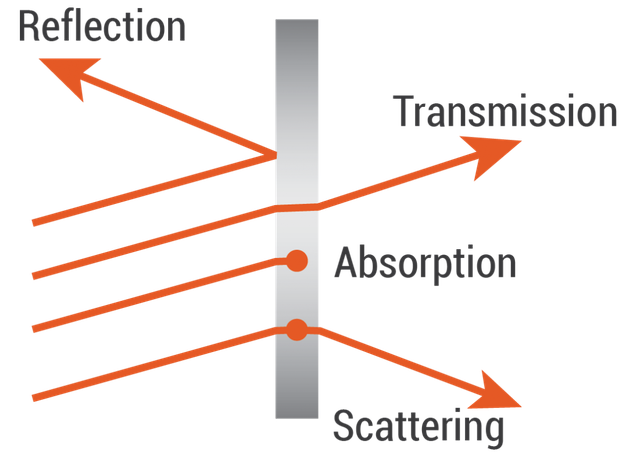
Phenomena that occur when light encounters an object
When light hits the surface of a material, it only penetrates the object (Transmission), and the material looks transparent at this time, such as a single cellulose fiber, or a very thin, very dense high-purity cellulose paper, tracing paper, parchment, glassine paper or nanocellulose.

However, paper is usually not simply composed of a single layer of fibers, but a multi-layer fiber mesh with many pores. At this time, light is reflected or scattered on the paper, and the paper looks white.
In fact, pure cellulose fiber does not absorb light, so it looks transparent.
- If light only absorbs light when it encounters an object, and no light enters the observer’s eyes, then the substance will appear black.
- If light only reflects and scatters light when it encounters an object, then the object looks white (White).
- If more light is emitted and scattered, more light returns to the observer’s eyes, and the object looks brighter (Brighter).
Whiteness and brightness
Here we better separate the two basic concepts of color and intensity (“amount of light”).
Whiteness refers to color, and brightness refers to the amount of light coming from an object.
If the amount (or wavelength spectrum) of incident and scattered light is the same, then the object appears white in sunlight.
Smooth ice sheets have only two surfaces, the top and the back, with a small interface area that can reflect or scatter light.
Snow is made up of many small snowflakes, which have a complex structure and a very large surface area that interacts with light. Therefore, snow looks very bright, as shown in the figure below.
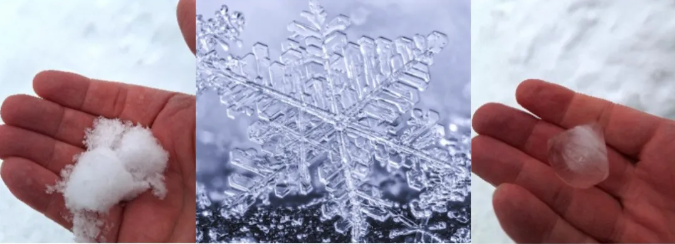
Therefore, the surface area per unit weight of a material (i.e., specific surface area, in m2/g) is very important for brightness. Snow is composed of many small snowflakes with a large specific surface area, which will scatter light a lot. In addition, the density of snow is also low (20-180 kg/m3); ice has a small surface area and a high density (~917 kg/m3). Therefore, density is negatively correlated with light scattering ability.
As shown in the figure below, if the paper is composed of several finer fibers (e.g., fibers with low thickness), the number of air-fiber interfaces will be many times greater than if it is composed of one thick fiber.
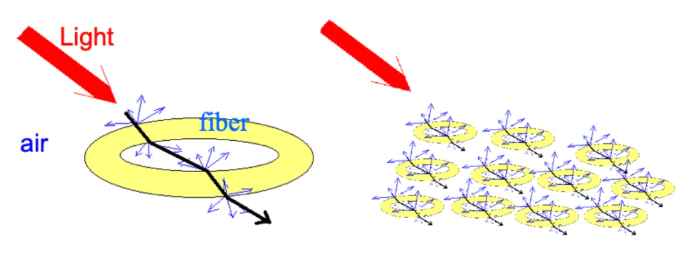
The same phenomenon also explains why fibers with lower thickness have higher light scattering ability (coefficient) than fibers with higher thickness. Acacia and Eucalyptus pulps can produce brighter paper compared to softwood pulp (as shown in the figure below).
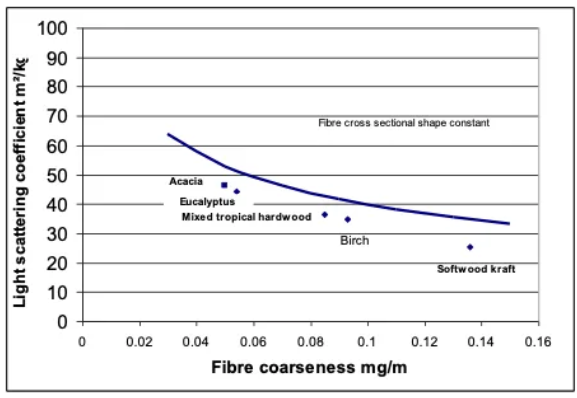
The effect of fiber coarseness on the light scattering coefficient of paper
Compacting the paper web (wet pressing) reduces the number of pores and light scattering surfaces in the paper, increases fiber-fiber contact, and thus reduces light scattering and brightness.
In other words, when we increase the strength of the paper by increasing the number of fiber-fiber bonding points (refining), the optical properties of the paper (brightness and light scattering) decrease.
Kubelka-Munk Optical Theory
There are many theories that describe different aspects of the optical properties of materials. Among them, the most classic is the Kubelka-Munk Optical Theory (hereinafter referred to as K-M theory). K-M theory 1is widely used to explain these optical phenomena of paper.
There are two basic concepts in K-M theory: light absorption coefficient and light scattering coefficient. Using these two concepts plus the basis weight of the paper, it is possible to explain and even calculate the relationship between these factors and the brightness or reflectivity, opacity and transmittance of the paper; it can also be used to calculate the impact of different pulp mixtures on these optical properties.
The concept of light
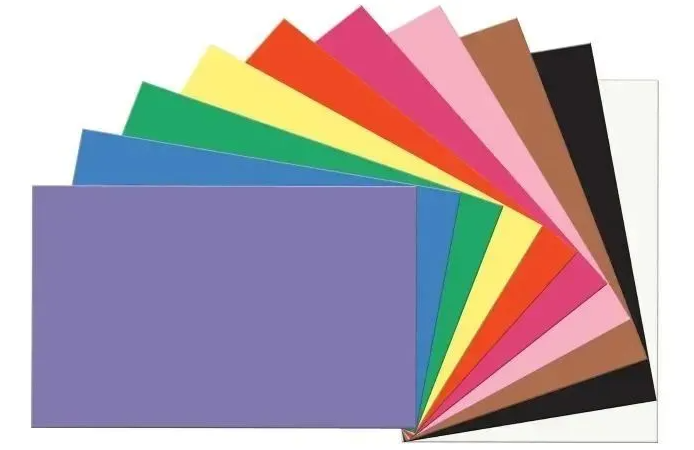
Color is not as simple as we think. Copy paper appears white when illuminated by white light. If the light is red, then the paper appears red. If the light is green, then the white paper appears green.
The color a person sees depends on three main factors:
1) the properties of the incident light;
2) the properties of the material (in this case, the white paper);
3) the properties of the perceiver.
Sunlight is a type of radiation that can be physically described as waves with a finite speed and wavelength. Importantly, sunlight is a collection of a broad spectrum of radiation. And we humans can only see a portion of it. Visible light has a wavelength range between 400 and 700 nanometers (nm).
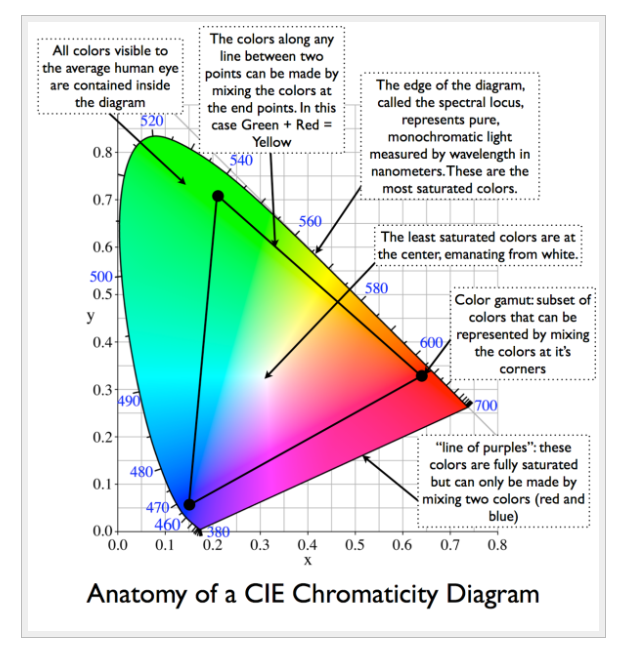
The wavelength spectrum of solar radiation and the radiation intensity at different wavelengths
For a surface, such as paper, to appear red in sunlight, the reason is that part of the light is absorbed by the paper, and the light reflected or scattered from the paper is red light. Most materials and compounds absorb light. Even water vapor and clouds in the atmosphere absorb certain wavelengths, thus changing the spectrum of the incident light.
Evolution has enabled us to perceive different colors at different wavelengths in the visible range. Wavelengths close to the lower limit of 400nm, we see blue, and close to the upper limit of 700nm, we observe red. Next to the visible light spectrum are ultraviolet light with shorter wavelengths (below 400nm) and infrared light with wavelengths above 700nm.
Color is subjective
Why do we humans see color?
There are three types of cells or receptors in our eyes that are sensitive to different regions of the visible spectrum. The combination of perceived intensities of these receptors, the cones, are processed in the brain and make it see color. It can be said that the physical world is colorless, they are the product of our brain and visual system.
In a sense, we humans are lucky because our world is colorful. Many animals have no color vision or very poor color vision, such as dogs, cats, mice, rabbits; some animals, such as birds, can have a wider color vision than humans; some animals, such as snakes, can detect radiation that we cannot see, namely infrared light.
The fact that seeing color is subjective can also cause a lot of difficulties for papermakers and printers. However, systems have been developed that can objectively define and measure colors. One such system is called CIE chromaticity, and with this system it has become possible to reproduce the desired color.
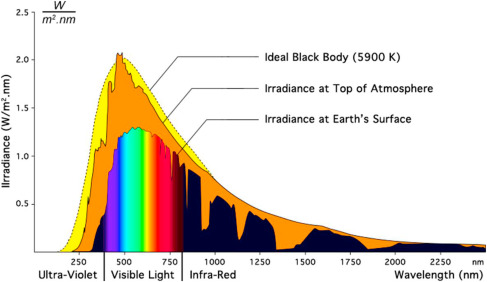
CIE color space chromaticity diagram
Challenges of Color in the Paper Industry
Papermakers are often required to produce paper of a certain color, that is, paper with a certain hue. For example, paper converters and printers may not be able to accept the paper or cardboard packaging they print even though the printing color is not much different from the brand color.

Well-known internationally registered trademarks with specific colors (pictured above) are examples of Coca-Cola red and Marlboro red. Getting the exact color on the packaging depends not only on the color of the printing ink, but also on the color of the background, i.e. the paper or plastic board.
Paper made from unbleached or only lightly bleached pulp is more challenging in this regard, because only certain colors can be printed on it. The color of unbleached or only lightly bleached pulp mainly comes from lignin.
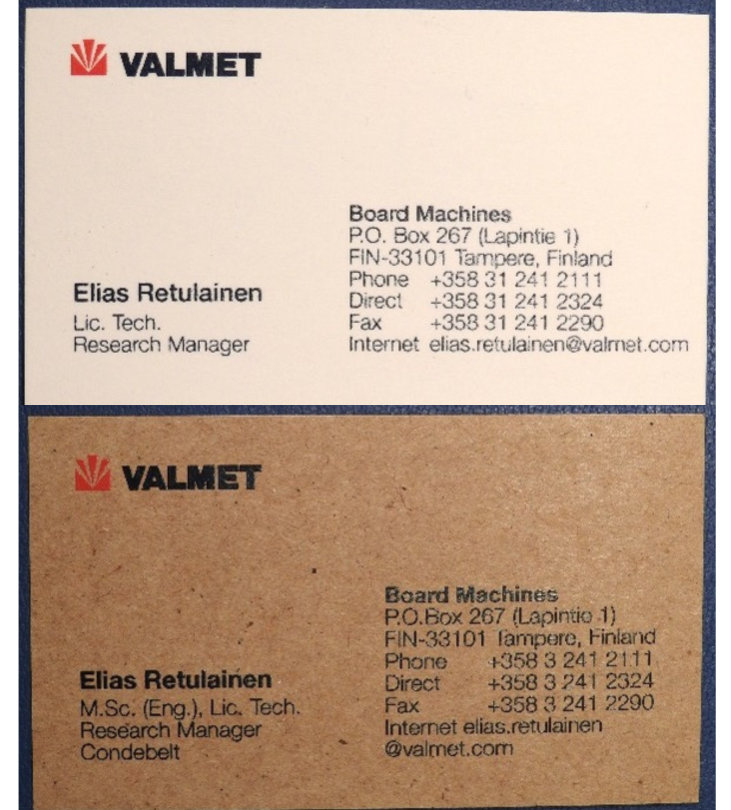
The same information appears differently on different papers, giving people different impressions.
How to make paper look whiter?
Studies have found that slightly bluish paper looks whiter to the human eye than yellowish paper. Therefore, paper mills can add some blue to the paper stock, although the amount of reflected light may be reduced. There are also cultural differences in preferences.
- A common way to increase the amount of light reflected from the surface of paper and make it look brighter and whiter is to use optical brighteners (OBAs). These substances have a special ability to absorb ultraviolet light, which we humans cannot see. What is reflected back are waves of higher wavelengths that we can see. Therefore, the paper looks whiter and brighter. OBA is also widely used in some other industries, such as the textile industry, and even in some detergents.
- Another way to make paper look whiter is to use pigments. Pigments have small particles and a high specific surface area, which increases the light scattering area of the paper. They also have a higher refractive index than cellulose. The refractive index refers to the degree to which light is bent when it enters a material. Typical pigments are calcium carbonate, kaolin, and talc. They do not actually absorb light, but reflect it. But due to the high scattering ability, it also makes the paper look brighter and more opaque.
- A particularly effective but expensive pigment is titanium dioxide, which is often used to make thin paper products, such as decorative base paper. The smaller the particles, the better, because they have a larger specific surface area. But when the size of the particles becomes smaller and approaches the half wavelength of light, there is an additional mechanism that increases the scattering of light. Although from an optical point of view, the smaller the particles, the better. However, if the pigment particles are too small, it is difficult to retain them in the fiber network structure when the paper machine is formed. However, coating the paper surface makes it easier to use pigments with smaller particles.
- The colors described above are all produced by absorbing specific wavelengths based on the chemical composition of the material. However, another new mechanism that can produce color is the nanoscale structure of the material. The color of butterfly wings, the color of peacock feathers (shown below), and the film of oil on water are good examples. The color here is produced by various nanostructures or layers reflecting and refracting light in different ways. Simply put, this means that due to the diffraction and interference of waves, some wavelengths are weakened and others are enhanced. This will also provide new possibilities for paper coloring, such as giving the paper surface a nanostructure.
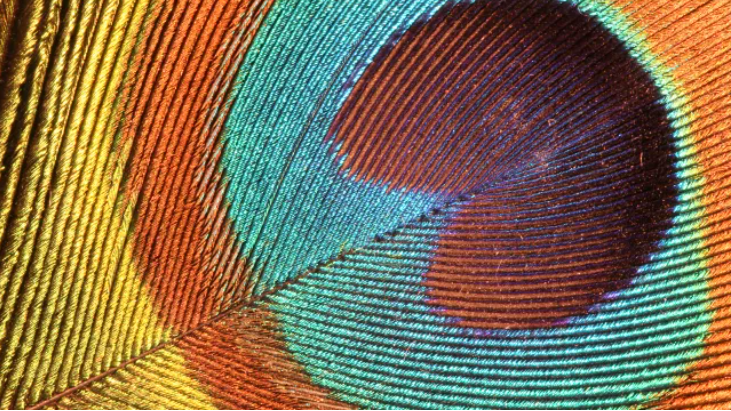
Peacock Feather Color
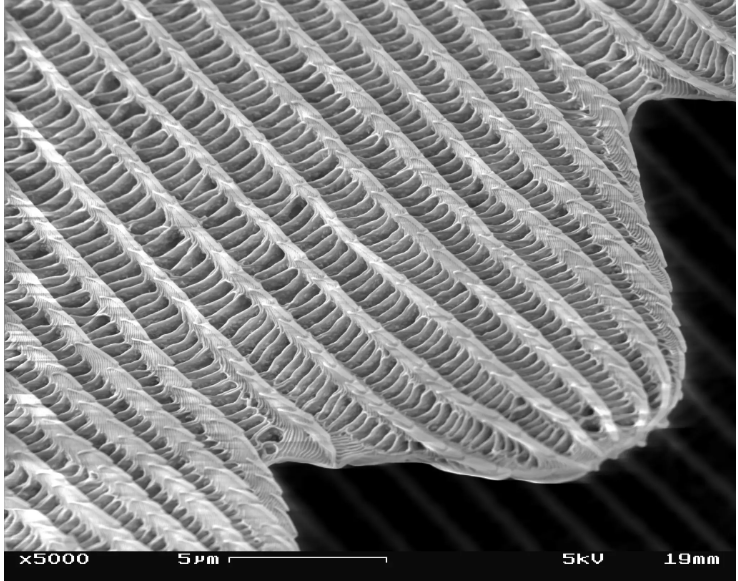
SEM image of peacock butterfly wings
- The Kubelka-Munk theory, devised by Paul Kubelka and Franz Munk, is a fundamental approach to modelling the appearance of paint films. ↩︎